

Why HACCP Is Important for Food Businesses & How to Apply in Malaysia
January 2, 2026
How to Apply for ISO 22000 Certification in Malaysia: Essential Steps to Get Certified
June 25, 2026
Your HACCP audit is coming up, and even small preparation gaps can lead to non-conformances, delayed certification, supplier approval issues, or extra corrective work after the audit.
Many Malaysian food businesses already understand why HACCP matters, but audit readiness comes down to execution. Your team needs clear records, updated procedures, proper monitoring, and enough confidence to answer auditor questions correctly.
Here is what to focus on before the audit, the HACCP audit mistakes to avoid, and the role of One Island’s HACCP training in Malaysia that helps your team prepare ahead.
What Auditors Are Actually Looking For

Auditors are verifying that the plan is accurate, actively implemented, and supported by evidence based on specific requirements.
During a HACCP audit, you can expect auditors to review:
- Your HACCP plan documentation, including hazard analysis, CCP identification, and critical limits
- Monitoring records that show CCPs are being tracked in real time
- Corrective action logs for any deviation from critical limits
- Verification and validation activities, such as internal audits and testing results
- Staff training records to confirm that your team understands their HACCP responsibilities
- Calibration records for all monitoring equipment
Learn more about why HACCP is important and the difference between ISO 22000 vs HACCP.
How to Prepare for a HACCP Audit
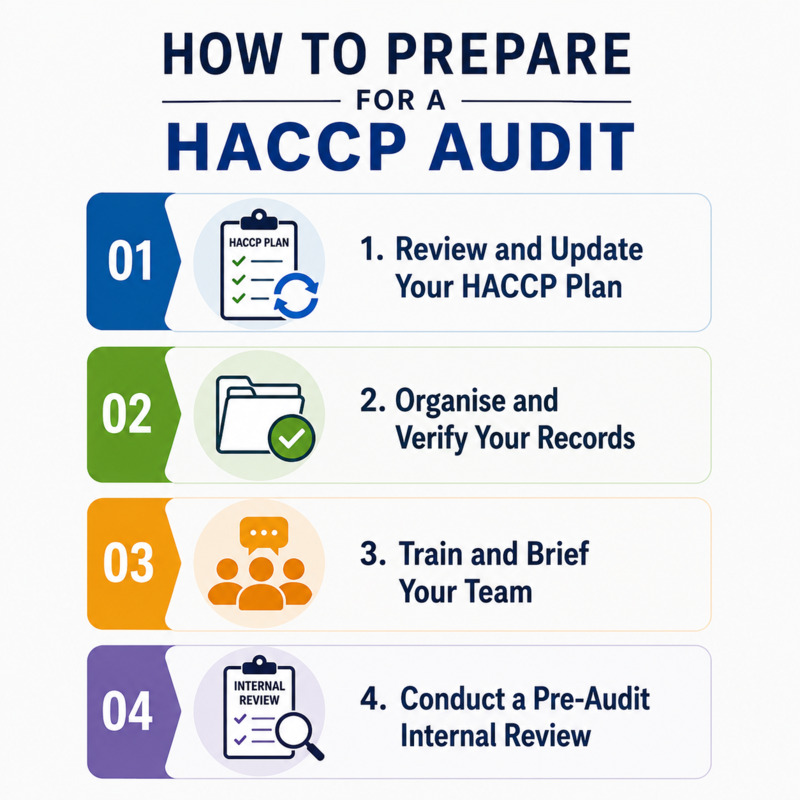
A smoother HACCP audit starts with early preparation, organised records, and a team that understands its role during the assessment.
1. Review and Update Your HACCP Plan
Start by pulling out your current HACCP plan and treating it as a live document rather than a one-time submission.
If your production process, ingredients, equipment, or suppliers have changed since the plan was last reviewed, those changes need to be reflected.
Key questions to ask during your review:
- Are all hazards (biological, chemical, allergen, physical) still accurately identified?
- Are your CCPs still valid based on your current process flow?
- Do the critical limits align with current regulatory requirements in Malaysia, including those under the Food Act 1983 and Food Hygiene Regulations 2009?
- Has any new process step or ingredient been added without a corresponding hazard analysis?
2. Organise and Verify Your Records
Documentation is where most businesses lose points during a HACCP audit. Your records need to tell a complete, consistent story, such as hazard identification through and ongoing monitoring.
Before your audit, compile and cross-check the following:
- Monitoring logs for each CCP, with dates, readings, and signatures
- Corrective action records for every deviation recorded over the past 12 months
- Internal audit reports and management review minutes
- Supplier verification documents, such as Certificates of Analysis or food safety declarations
- Equipment calibration certificates, all within their validity period
- Training records with staff names, training topics, dates, and signatures
Tip: Group your documents by HACCP principle. Auditors move through the seven principles systematically, and having your records organised the same way speeds up the review significantly.
3. Train and Brief Your Team
Auditors regularly interview floor staff to verify that procedures are understood and followed.
Make sure every team member involved in food handling or monitoring can answer:
- What is a CCP, and which ones apply to their work area?
- What do they do if a critical limit is breached?
- Where are the monitoring records kept, and how are they filled in?
4. Conduct a Pre-Audit Internal Review
Walk through your facility the way an auditor would: observe actual practices, compare them to your documented procedures, and note any gaps.
This is also the stage where an external consultant adds value.
One Island Consultancy works with Malaysian food businesses to conduct structured pre-audit gap assessments, identifying non-conformances before they become official findings.
5 Common HACCP Audit Mistakes (and How to Fix Them)
Even well-run food businesses make avoidable errors during HACCP audits. Below are the most frequent HACCP audit mistakes our consultants see, along with practical fixes.
| HACCP Audit Mistake | Impact | How to Fix It |
| Vague or missing CCP documentation | Audit failure, certification delay | Use precise numeric limits with monitoring logs |
| No verification records for corrective actions | Non-conformance finding | Document every deviation and action taken |
| Outdated HACCP plan (post-process change) | Plan invalidated | Trigger a review after any process, supplier, or equipment change |
| Inadequate training records | Staff knowledge gaps flagged | Keep signed training logs per employee, per procedure |
| Calibration records missing or expired | Monitoring data questioned | Schedule and record calibration for all monitoring equipment |
One Island’s HACCP consultants help businesses close these gaps efficiently for first certification preparation or a renewal audit.
Why CCP Definition Is Where Most Plans Fall Apart

Of all the elements in a HACCP plan, Critical Control Points receive the most scrutiny.
This is because CCP errors tend to cascade: a poorly defined CCP leads to an inaccurate critical limit, which leads to monitoring records that cannot be relied on, which leads to corrective actions that do not address the actual risk.
The two most common CCP mistakes we see are:
1. Setting CCPs Without a Decision Tree
The Codex Alimentarius decision tree exists to help teams make this distinction consistently.
Skipping this step often results in either too many CCPs (creating monitoring burden) or too few (leaving genuine risks uncontrolled).
2. Using Vague Critical Limits
A critical limit such as “cook to sufficient temperature” is not auditable.
Your limits need to be specific, measurable, and referenced to a validated standard.
For example, the internal product temperature must reach 75 degrees Celsius for a minimum of 15 seconds, as per Malaysian Food Regulations.
What Happens After the HACCP Audit
Your audit may end with full certification, conditional approval, or corrective actions to complete.
- No non-conformances: Certification is granted or renewed. Keep your monitoring records active and schedule your next internal audit.
- Minor non-conformances: You will typically have 30 to 90 days to submit evidence of corrective actions. Address the root cause, not just the symptom.
- Major non-conformances: These require a follow-up audit. Engage a consultant to help you close gaps systematically and avoid repeated findings.
Knowing the next step helps your team respond quickly and keep the certification process moving.
Get Audit Ready with One Island’s HACCP Training
ISO training provider, One Island’s HACCP training helps your team close audit preparation gaps before they become non-conformances.
The training guides your staff through HACCP requirements, audit expectations, documentation control, monitoring records, corrective actions, and practical implementation in daily operations.
Through the training, businesses can:
- Prepare staff to answer auditor questions with more confidence
- Improve HACCP documentation before the audit date
- Strengthen awareness of CCPs, monitoring, and corrective actions
- Reduce repeated mistakes caused by poor internal understanding
- Support smoother preparation for HACCP certification and compliance audits
This training is useful for food manufacturers, central kitchens, F&B operators, food packaging companies, and businesses preparing for customer or supplier audits.
Contact One Island today to find out how we can help your business pass its HACCP audit with confidence.
Frequently Asked Questions About HACCP Audit Preparation
Most businesses need a few weeks to several months, and One Island’s HACCP training helps your team focus on the key areas auditors will review.
You usually need your Pre-Requisite Programme (PRP) procedures, HACCP plan, hazard analysis records, CCP monitoring logs, corrective action records, verification records, calibration records, and staff training records.
Common mistakes include incomplete records, outdated procedures, unclear CCP monitoring, missing corrective actions, and staff who are not ready for auditor questions.
Yes, One Island’s HACCP training helps your team understand HACCP requirements, improve documentation, and prepare for audit expectations.
Not always, but working with One Island gives your business clearer guidance, structured preparation, and stronger support before the audit.