
6 Key Benefits of ISO 42001 for AI-Driven Startups
June 26, 2026
Malaysian businesses across sectors such as finance, manufacturing, healthcare and professional services are actively deploying AI systems to drive efficiency and growth. But as AI adoption accelerates, so does the question of accountability: how do you ensure your AI is used responsibly, consistently and in line with regulatory expectations?
ISO 42001 AI Governance gives organisations a structured framework to govern AI ethically, manage risks and demonstrate accountability to clients, regulators and stakeholders.
Let’s walk through exactly how to implement ISO 42001, what each stage involves and how ISO training provider, One Island Consultancy can support your business throughout the certification journey.
Who Should Implement ISO 42001?
ISO 42001 is relevant for any organisation that uses, develops or procures AI systems. You do not need to be a technology company to pursue certification. If AI touches your operations in any meaningful way, the standard applies.
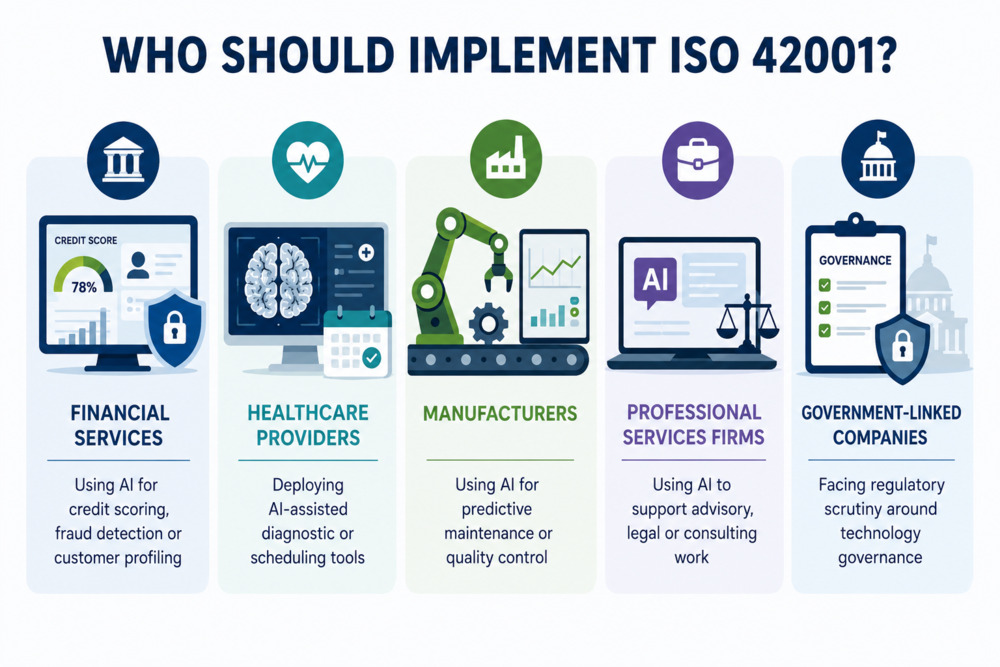
The earlier your organisation puts AI governance in place, the easier it becomes to manage risk, meet buyer expectations, and build trust as AI use grows.
ISO 42001 Certification vs. Implementation: What Is the Difference?
Some organisations choose to implement ISO 42001 as an internal governance framework without pursuing formal certification.
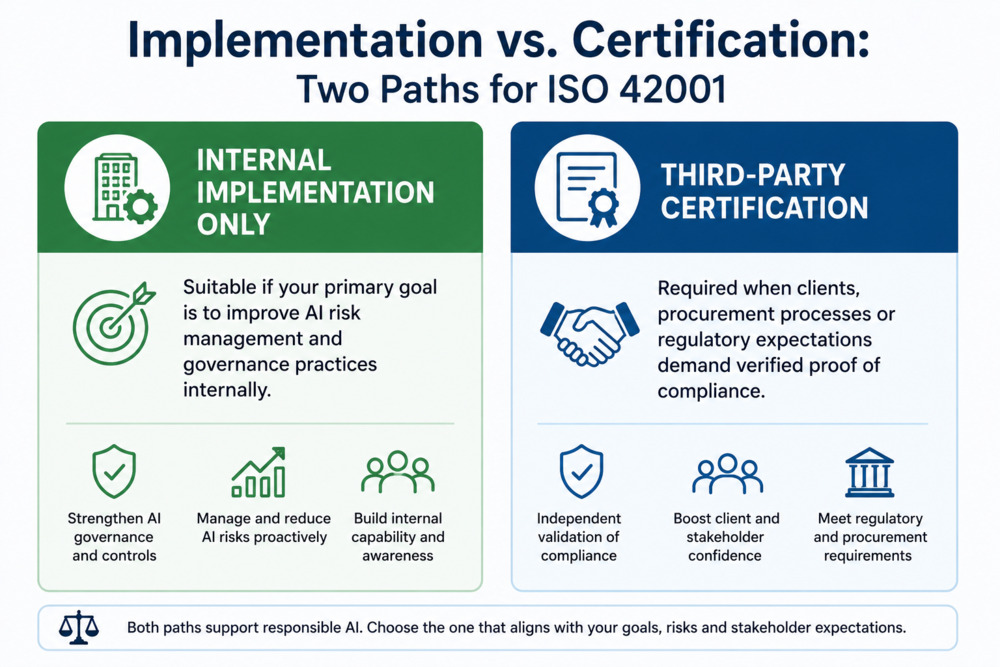
Others pursue third-party certification from an accredited certification body to demonstrate compliance to clients and regulators.
Find out the benefits of ISO 42001 for AI governance in Malaysia.
8-Stage ISO 42001 Audit Checklist for Implementation
Implementing ISO 42001 follows a structured process built around the Plan-Do-Check-Act (PDCA) cycle. Here is a practical overview of each stage:
| Stage | Key Activities | Outcome |
| 1. Gap Analysis | Review current AI policies, practices, and risks against ISO 42001 requirements | Clear picture of compliance gaps |
| 2. Leadership Buy-in | Brief top management; assign an AI management system owner | Governance structure in place |
| 3. AI Policy & Scope | Draft your AI policy; define scope of the management system | Documented foundation |
| 4. Risk Assessment | Identify AI-related risks including bias, transparency, and misuse | Risk register and controls |
| 5. Controls & Documentation | Implement Annex A controls; build procedures and records | Audit-ready documentation |
| 6. Training & Awareness | Train staff on AI ethics, risks, and their responsibilities | Competent, aware teams |
| 7. Internal Audit | Conduct internal audit against the standard | Pre-certification readiness check |
| 8. Certification Audit | Engage accredited certification body for Stage 1 and Stage 2 audits | ISO 42001 certificate issued |
The timeline for implementation typically ranges from three to nine months depending on the size of your organisation, the complexity of your AI systems and how mature your existing governance practices are.
One Island Consultancy works with you to build a realistic project plan from the outset.
Want to protect from cybersecurity risks impacting your business? Here’s how to prepare for ISO 27001:2022 certification in Malaysia.
6 Key Clauses of ISO 42001 You Need to Understand

ISO 42001 is structured around familiar management system clauses (Clauses 4 to 10), but with AI-specific requirements layered in. The areas that most organisations need to focus on include:
- Context and Stakeholder Needs (Clause 4): Understanding the internal and external factors that affect your AI governance, including legal, regulatory and ethical considerations relevant to Malaysia.
- Leadership and Policy (Clause 5): Top management must demonstrate commitment by establishing an AI policy and assigning clear roles and responsibilities for AI governance.
- AI Risk and Impact Assessment (Clause 6): Identifying risks associated with your specific AI use cases, including potential bias, transparency failures and impacts on individuals.
- Operational Planning and Controls (Clause 8): Implementing the technical and procedural controls required to manage AI responsibly, drawing from Annex A of the standard.
- Performance Evaluation (Clause 9): Monitoring and measuring your AI management system through internal audits and management reviews.
- Continual Improvement (Clause 10): Addressing nonconformities and driving ongoing improvement across your AI governance practices.
Understanding these clauses helps organisations turn ISO 42001 into a practical AI governance system that supports safer, more accountable AI use.
Speak to One Island Consultancy today to strengthen your AI governance practices and prepare your organisation for ISO 42001 certification.
4 Common Challenges During ISO 42001 Implementation
Many organisations underestimate the documentation and cross-functional coordination required to implement ISO 42001 effectively.
- Lack of AI inventory: Organisations often do not have a clear picture of all AI systems in use across departments.
- Unclear ownership: AI governance tends to fall between IT, legal and business teams with no single owner.
- Generic risk assessments: Risk assessments that are not tailored to specific AI use cases fail to satisfy auditors.
- Insufficient training: Staff using or overseeing AI systems need to understand their obligations under the management system.
One Island Consultancy helps you avoid these pitfalls by providing structured guidance, documentation templates and expert support at every stage.
Our consultants have hands-on experience with ISO management system implementations across Malaysian industries, and we adapt our approach to your specific organisational context.
Strengthen Your AI Governance with ISO 42001 at One Island
AI governance is becoming a serious business priority. ISO 42001 helps your organisation manage AI risks, strengthen accountability, and show clients that your AI practices are controlled, responsible, and audit-ready.
One Island Consultancy supports Malaysian organisations through practical ISO 42001 training, gap analysis, implementation guidance, and certification audit preparation. Our team helps you understand the requirements clearly and apply them to your actual AI use cases.
Speak to One Island Consultancy today to start building a stronger AI governance system and move your organisation closer to ISO 42001 certification.
Frequently Asked Questions about ISO 42001 Implementation in Malaysia
Most organisations complete ISO 42001 implementation within 4 to 9 months, depending on AI complexity, documentation readiness, and internal processes.
Yes. One Island Consultancy provides ISO 42001 training, gap analysis, implementation support, documentation guidance, and audit preparation support.
No. ISO 42001 can be implemented independently, although existing ISO systems can help speed up the process.
Yes. ISO 42001 can be scaled based on your organisation size, AI usage, and operational requirements.
ISO 42001 helps organisations strengthen AI governance, manage AI risks, improve accountability, and support responsible AI use.