
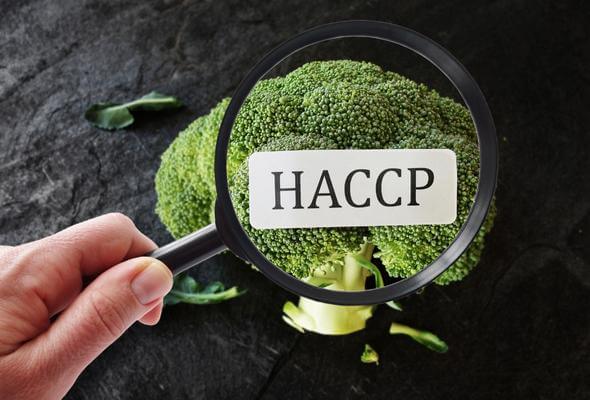
HACCP Training and Certification Support
HACCP is a preventive food-safety system used to identify and control biological, chemical and physical hazards across production, processing and distribution. One Island’s HACCP training in Malaysia follows the Codex HACCP framework and prepares food-safety teams to apply the controls in daily operations. Participants learn how the seven principles connect to the actual process flow, monitoring records and corrective action.
Consultancy support can cover the HACCP plan, prerequisite programmes, validation, internal audit and preparation for HACCP certification in Malaysia under the applicable Malaysian scheme. The consultant works with production and quality teams to confirm hazards, critical limits, responsibilities and evidence before the external assessment.
For food businesses asking how to get HACCP certification, the work starts with prerequisite programmes, an accurate process flow and a hazard analysis supported by technical evidence. One Island helps the HACCP team assign monitoring responsibilities, define records and close gaps before the certification assessment.
HACCP Certification Course Options in Malaysia
| Course | Typical Duration |
Level | Who it suits |
|---|---|---|---|
| HACCP Awareness Training, Codex based | 1 day | Awareness | Food handlers, production and QA teams new to HACCP |
| Combined GMP and HACCP Programme | 2 days | Awareness plus application | Manufacturers building both systems together |
| HACCP Internal Audit Training | 1 day | Internal auditor | Appointed internal auditors and food safety team leaders |
| HACCP Plan Development Workshop | 1 to 2 days | Application | Food safety teams writing their own HACCP plan |
Training format and claimability
Eligible training programmes may be claimable under HRD Corp's SBL Khas scheme, subject to employer eligibility and programme approval. Typical duration and delivery format are confirmed after the programme scope is reviewed, and completion certificates are provided for applicable courses.
Participant suitability and preparation
Awareness training suits food handlers, production staff and quality teams new to HACCP. Internal-auditor participants should understand the HACCP plan or complete awareness training first. Plan-development workshops require the current process flow, product information and prerequisite-programme records. Delivery mode and completion certificates are confirmed with the programme schedule.
GMP vs HACCP: What’s the Difference?
Understanding the difference between GMP (Good Manufacturing Practice) and HACCP (Hazard Analysis and Critical Control Points) helps food businesses build a reliable food safety system and prepare the right training path.
| Aspect | GMP (Good Manufacturing Practice) | HACCP (Hazard Analysis & Critical Control Points) |
|---|---|---|
| Focus | General hygiene, facility cleanliness, employee practices | Identifying and controlling specific food safety hazards |
| Scope | Covers all aspects of production, from facility layout to staff hygiene | Focuses on critical points in the food process that can cause harm |
| Approach | Preventive – sets up the foundation for safe food production | Risk-based – targets specific hazards and controls them |
| Requirement | Mandatory in many countries for food and beverage facilities | Required for certain food exports and higher-level certifications |
| Implementation | Implemented as standard operating procedures (SOPs) | Implemented through a structured 7-step plan |
| Goal | Ensure consistent and clean production environment | Prevent food safety hazards from reaching the consumer |
| Documentation | Includes SOPs, cleaning schedules, maintenance logs | Includes hazard analysis, CCP monitoring, corrective action records |
| Certification | Often a prerequisite for HACCP | Builds on GMP and leads to internationally recognised certification |
Who Should Attend the Course
There are no formal prerequisites. Participants should be familiar with the products, process flow and food-safety controls used at their site.
How to Get HACCP Certification in Malaysia: The 7 Principles
One Island’s ISO consultant guides the HACCP team through the seven principles, linking each control to the process flow, monitoring records and corrective-action responsibilities.
Conduct a hazard analysis
We help identify the biological, chemical and physical hazards present at each stage of your process.
Determine critical control points
Together we pinpoint where control is essential to eliminate or reduce each hazard.
Establish critical limits
We assist in setting measurable safety thresholds such as temperature, pH and humidity at each CCP.
Set up monitoring procedures
We define who monitors, when and how, so processes stay inside safe limits.
Establish corrective actions
Our consultants prepare clear action plans for deviations, protecting your product and your customers.
Verify the system
We run audits, tests and reviews to confirm the HACCP system works as intended.
Maintain documentation and records
We organise the documents and records the certification body and regulators will ask to see.
Eight Benefits of Getting Certified
HACCP Certification Under the Malaysian Scheme
Malaysia operates a certification scheme for Hazard Analysis and Critical Control Point systems in the food industry. The assessment reviews the HACCP plan, prerequisite programmes, implementation records and evidence that controls are monitored. Each critical control point needs defined limits, assigned monitoring responsibility and records showing how deviations are handled.
One Island prepares the documentation and implementation evidence needed for the assessment, then supports the team in closing findings before the certification decision. The scope can also include refresher training, plan review and internal-audit support for an existing HACCP system.
The assessment focuses on the HACCP plan, prerequisite programmes, implementation records and evidence that critical controls are monitored. One Island can review the documentation, conduct the internal audit and support corrective-action closure before the application for HACCP certification in Malaysia.
How Much Does HACCP Certification Cost in Malaysia?
HACCP certification cost depends on the number of sites, product lines, existing GMP controls, training needs and certification-body audit scope. One Island prepares a quotation after reviewing the operation, process flow, current food-safety documentation and the level of support required.
Training costs may be partly claimable under HRD Corp’s SBL Khas scheme, subject to employer eligibility and programme approval. Consultancy and certification-body charges are scoped separately so management can see which cost belongs to each part of the project.
Related Food Safety Training and Certification
HACCP relies on effective prerequisite controls, so many food manufacturers begin with GMP certification and training. Businesses that need a complete management system may later progress to ISO 22000:2018 in Malaysia. The same food-safety team can often maintain the linked procedures and records.
One Island can coordinate the HACCP certification course, GMP implementation and ISO 22000 preparation around the same process flow and food-safety team. This keeps hazard controls, prerequisite programmes and audit evidence aligned.
Food exporters that also need to report sustainability data to buyers can pair this work with ESG awareness training in Malaysia, since export and retail customers increasingly ask for both food-safety and ESG evidence together.
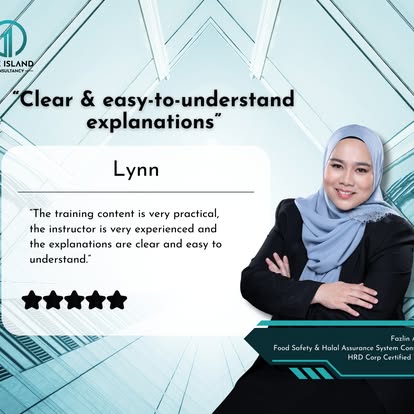
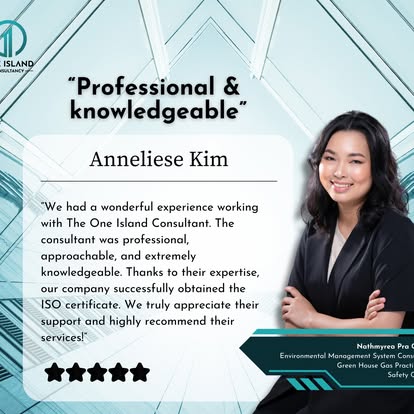
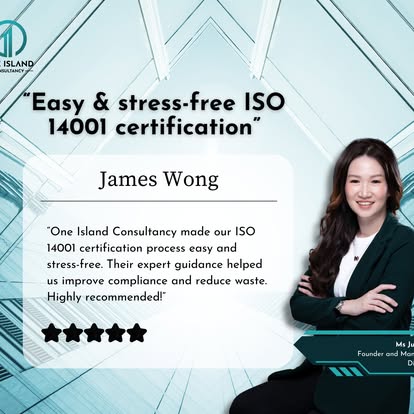
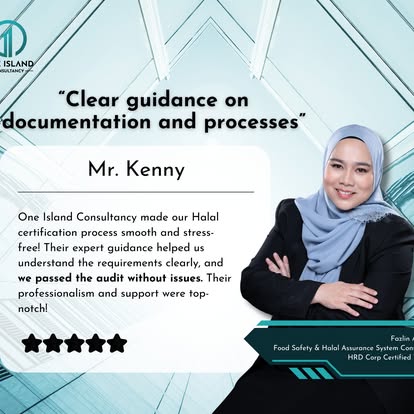
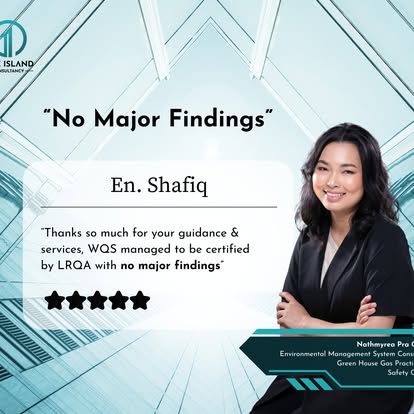
What Our Clients Say About One Island Consultancy







Frequently Asked Questions About HACCP Training and Certification
Answers to common questions about certification steps, cost factors, the seven HACCP principles and links with GMP and ISO 22000.
Book HACCP Training for Your Food Safety Team
Share your product categories, process flow, site count and current GMP controls. The course and consultancy scope can then be aligned with your HACCP plan and certification target.