

GMP Compliance Checklist: Essential Steps for Certification Success
June 25, 2026
How to Prepare for ISO 27001:2022 Certification: A Complete Guide for Businesses
June 25, 2026
Getting JAKIM Halal certification helps businesses prove that their products, processes, and operations meet Malaysia’s official halal standards. For food, cosmetics, pharmaceuticals, and logistics companies, it also builds trust and strengthens market access.
However, many applications face delays due to weak documentation, unclear internal controls, or poor audit readiness.
This guide breaks down the key JAKIM Halal requirements, application process, and preparation steps before certification.
What Is JAKIM Halal Certification?
JAKIM Halal certification is the official halal endorsement issued by the Department of Islamic Development Malaysia (JAKIM).
It verifies that a product, service, or facility complies with Islamic law (Shariah) and Malaysia’s MS 1500 halal standard for food, as well as other relevant halal standards for non-food sectors.
The certification is widely recognised, with Malaysia’s halal logo accepted in over 80 countries. Holding a valid JAKIM certification is a commercial advantage for reaching more Muslim consumers..
Malaysia’s halal certification system is recognised internationally, making it one of the most valued halal endorsements a product can carry.
Contact One Island Consultancy today for a consultation and find out how our certification support and training programmes can get you audit-ready.
Who Needs JAKIM Halal Certification?
JAKIM Halal certification applies to a broad range of businesses across multiple sectors. Your business likely needs it if you fall under any of the following categories:
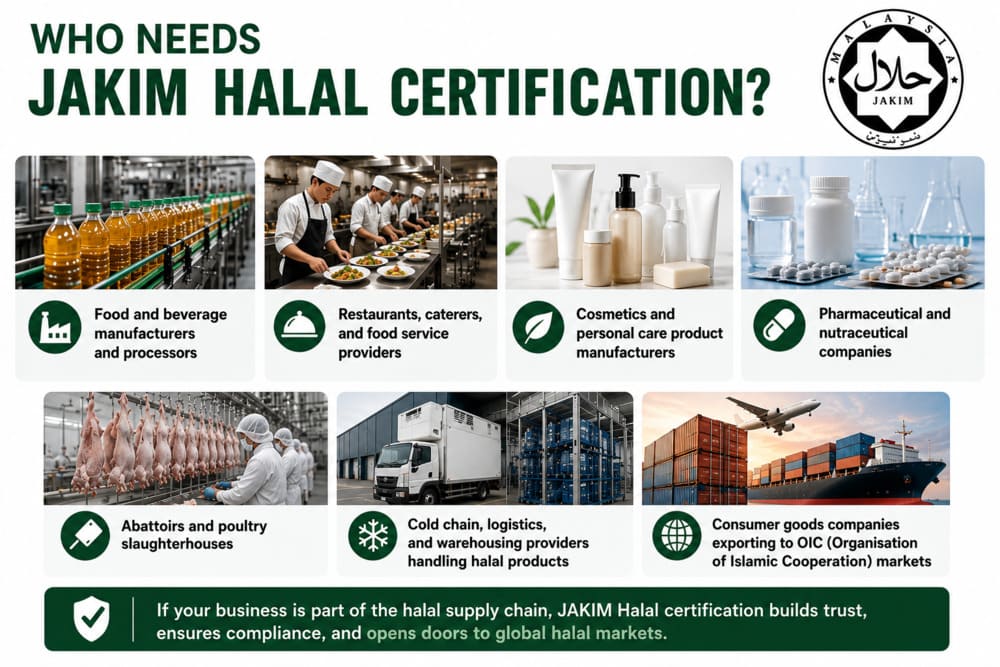
Even if certification is not legally mandated in your sector, many retailers, exporters, and corporate buyers require it as a condition of doing business.
JAKIM Halal Certification Requirements: What You Need to Prepare

Your business needs the right systems, records, and controls to show that halal compliance is already being managed properly.
1. Halal Assurance System (HAS) or Internal Halal Control System (IHCS)
Your business must have a documented Halal Assurance System or Internal Halal Control System. This includes written halal policies, designated halal committee members, standard operating procedures for handling halal products, and internal audit mechanisms.
JAKIM auditors will assess whether your HAS / IHCS is functional and consistently implemented, not just documented on paper.
2. Ingredient and Raw Material Verification
All ingredients and raw materials used in your product must be verified as halal.
You will need to provide supplier documentation, halal certificates for each ingredient, and evidence that no non-halal substances are used or come into contact with your product during processing.
3. Premise and Equipment Standards
Your production facility, equipment, and storage areas must meet halal hygiene and segregation standards. This means no cross-contamination with non-halal substances, proper cleaning and sanitation protocols, and physical separation where required.
For slaughterhouse applications, specific requirements apply to the slaughter process and personnel.
4. Business Registration and Licensing
Your business must be registered with the Companies Commission of Malaysia (SSM) or the relevant authority for your sector.
You will also need any applicable manufacturing or trading licences to operate legally.
5. Halal-Competent Personnel
At least one Muslim employee must be appointed as a Halal Executive or Halal Supervisor. This person is responsible for overseeing halal compliance within your organisation.
Having trained personnel who understand halal principles and can manage audits is a key JAKIM requirement.
Speak with One Island Consultancy today to strengthen your halal compliance systems and improve your JAKIM audit readiness.
JAKIM Halal Certification Application Process
| Criteria | New Application | Renewal |
| Application Portal | MyeHalal (online) | MyeHalal (online) |
| Average Processing Time | 3 to 6 months | 3 to 6 months |
| Certificate Validity | 2 years – 3 years (depends categories) | 2 years – 3 years (depends categories) |
| Applicable Scope | Food & beverage, cosmetics & personal care, pharmaceutical, logistics, food premise, slaughter house, medical device, Open Equipment Manufacturer (OEM) and consumer goods | Food & beverage, cosmetics & personal care, pharmaceutical, logistics, food premise, slaughter house, medical device, Open Equipment Manufacturer (OEM) and consumer goods |
| Annual Surveillance | Required | Required |
Applications are submitted through the MyHALAL portal. Here is an overview of the key stages:
- Register your company on the MyHALAL portal and complete your business profile.
- Select the correct application category based on your product or service type.
- Upload all required documents, including ingredient halal certificates, HAS / IHCS documentation, premise layout, and business licences.
- Pay the applicable certification fees, which vary by category and business size.
- Undergo a premise audit conducted by JAKIM or an appointed certification body.
- Address any non-conformances raised during the audit.
- Receive your JAKIM Halal certificate upon approval, valid for two years in most categories.
The full process typically takes three to six months depending on document completeness and audit scheduling. Incomplete submissions or non-conformances during the audit are the most common causes of delays.
5 Common Challenges Businesses Face During Halal Certification
Many businesses underestimate how much internal preparation is required before applying. The most common issues include:
- Incomplete or outdated ingredient halal certificates from suppliers
- Poorly documented HAS / IHCS with no evidence of implementation
- Facility layouts that do not clearly show segregation of halal and non-halal areas
- Staff unfamiliar with halal requirements during the audit
- Missing or expired business licences at the time of application
These are not difficult problems to solve, but they do require systematic preparation.
Working with ISO training provider, One Island Consultancy that understands the JAKIM audit process can help you address gaps before they become rejection points.
Reduce Delays and Improve Halal Audit Readiness with One Island Training

One Island Consultancy helps businesses prepare for JAKIM halal certification through practical training, internal audit support, and halal system implementation guidance.
Our team works closely with your business to strengthen audit readiness and improve compliance before submission.
- Gap assessment based on JAKIM halal requirements
- HAS / IHCS documentation and implementation guidance
- Halal internal auditor training for staff and halal committees
- Pre-audit readiness reviews and non-conformance checks
- Compliance support for certification renewal
Businesses applying for halal certification for the first time, expanding operations, or preparing for renewal can benefit from structured guidance to reduce delays and improve audit preparedness.
Start Preparing for JAKIM Halal Certification with One Island
Good preparation helps businesses move through the JAKIM halal certification process with better confidence and fewer compliance issues. Organisations that strengthen their halal systems, documentation, internal controls, and staff awareness early are often better prepared for audits and certification reviews.
One Island Consultancy supports businesses through halal training, internal audit preparation, gap assessments, HAS / IHCS guidance, and certification readiness support tailored to JAKIM halal requirements.
Contact One Island Consultancy today to discuss your business goals and prepare your team for stronger halal compliance and audit readiness.
Frequently Asked Questions about JAKIM Halal Certification in Malaysia
Most businesses complete the process within 3 to 6 months, especially when documents, halal systems, and audit preparation are properly managed.
The fee depends on your business category, product scope, and company size, with official rates listed on the MyHALAL portal.
Yes, non-Muslim-owned businesses can apply as long as they meet JAKIM halal requirements and establish proper halal management controls.
Businesses must correct the non-conformances highlighted during the audit before certification approval can proceed.
Internal halal audits, staff training, proper documentation, and HAS / IHCS implementation help businesses improve audit readiness before assessment.
Yes, One Island Consultancy provides halal training, internal audit support, gap assessments, and compliance guidance to help businesses prepare for JAKIM certification.